
The Problem
Surprise medical bills—also known as “balance billing”—have long been one of the most pressing affordability concerns facing American families. Historically, most states allowed doctors to bill patients for any balance remaining after their health insurance paid its share. These charges were particularly devastating when out-of-network providers—who had no contractual rate agreements with insurers—billed patients for the full cost of care.
Today, with the No Surprises Act in place, patients are protected from most surprise medical bills. But new challenges have emerged. Certain private equity–backed providers and profit-focused intermediaries are now exploiting the law’s arbitration process as a business model to maximize revenue.
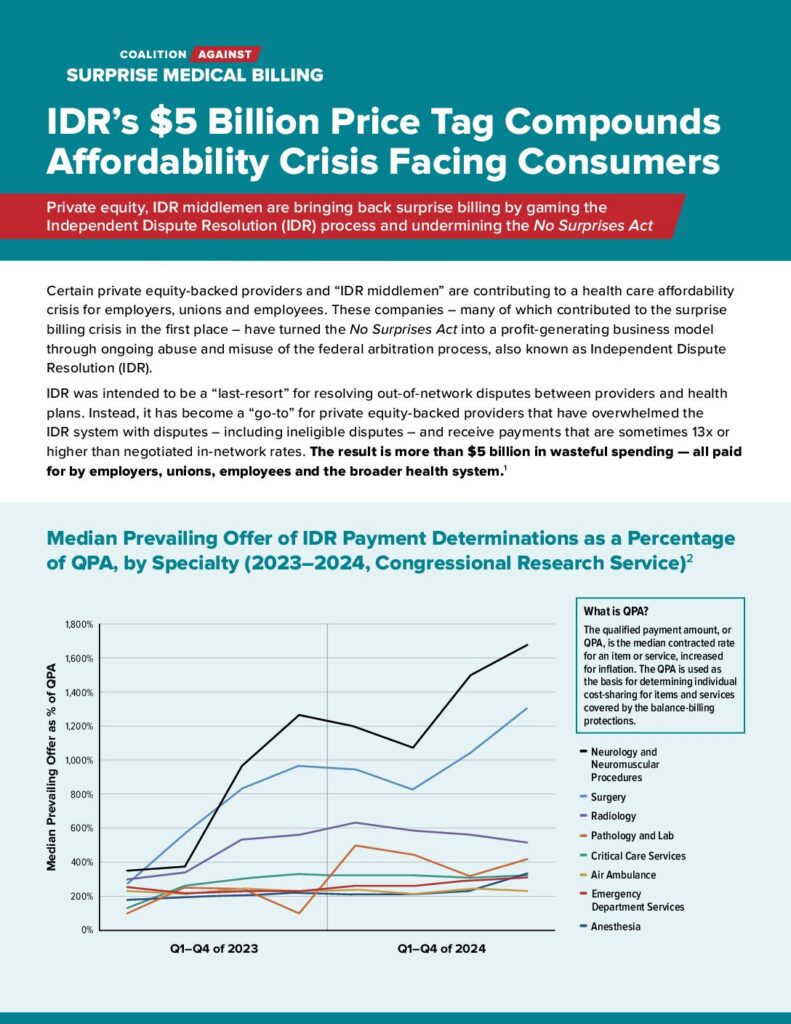
Instead of serving as a last-resort mechanism for payment disputes, the independent dispute resolution (IDR) process has been flooded with claims. Millions of cases have been filed since the law’s passage—far exceeding government projections—many of which are ineligible or inflated. This surge has created costly bottlenecks, slowed down legitimate dispute resolution, and burdened both health plans and employers with unnecessary administrative fees.
What’s more, data show that providers are prevailing more frequently in arbitration, and when they win, their awards are often many times higher than typical in-network or Medicare rates. This not only drives up direct costs for health plans but also raises premiums and out-of-pocket expenses for American families. Meanwhile, IDR entities are not required to provide full explanations of their decisions, and the law lacks a clear appeals process—leaving limited accountability or oversight.

Latest News
Stakeholders Voice Growing Support for Legislation to End Arbitration, Loopholes Within No Surprises Act
House Energy and Commerce Committee Ranking Member Representative Frank Pallone, Jr. (NJ-06) recently introduced the Lower Premiums, Faster Payments Act (H.R. 10788), which would stop costly abuse and misuse of arbitration by replacing the No Surprises Act’s...
Five Things to Know About the No Surprises Act’s Growing Arbitration Costs
Congress passed the No Surprises Act to end surprise medical bills, and it largely has for patients. But employers and working families are now facing a new surprise: higher premiums and shrinking provider networks, driven by certain providers’ and arbitration firms’...
IDR Was Projected to Handle 17,000 Disputes a Year. Now, It’s Over 7,000 a Day.
When Congress passed the No Surprises Act, the independent dispute resolution (IDR) process was intended to settle occasional payment disputes between providers and health plans. Regulators originally estimated that the process would handle 17,000 disputes a year. In...